Various Blogs regarding Cincinnati Family Law, Estate Planning And Bankruptcy.
At Bailey & Gunderson, our attorneys help people going through some of life's most difficult challenges. We bring our experience, skill and creativity to every case, taking on all types of Family Law including Divorce, Bankruptcy, Probate and Estate Planning issues. Learning that most people ask the same questions - this blog is our way of providing some general legal information. Feel free to contact our Cincinnati Law Offices to discuss your specific situation.
Due to the complexity of the probate laws and the steps that must be undertaken to properly administer an estate, it is highly recommended that fiduciaries, such as executors and administrators of decedent’s estates, retain an attorney well familiar with the probate process. Retaining an attorney shall prevent costly errors and shall ensure that the fiduciary is not cited by the Probate Court for the failure to properly perform their fiduciary duties or be sued by beneficiaries of the estate due to improper estate administration errors or the improper accounting and disbursement of estate funds and assets.
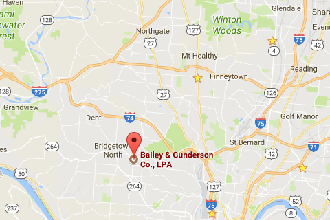
This insight into the law is provided by the attorneys at Bailey & Gunderson Co., L.P.A., with offices in Norwood and Western Hills, at 513-631-0022.
The most important issue to address when a marriage is being ended is the care, custody and well-being of the minor children. All of the local Domestic Relations Courts require that the parents complete parenting education to inform the parents regarding the impact of the termination of the marriage upon the minor children, and how to address the minor children’s needs after the marriage is terminated.
This insight into the law is provided by the attorneys at Bailey & Gunderson Co., L.P.A., with offices in Norwood and Western Hills, at 513-631-0022.
If so, we can help! A guardianship may be necessary for an incompetent relative, such as a parent, if you need to assume management over their financial matters and healthcare needs. A guardianship would be necessary if the parent does not have a durable power of attorney or a durable power of attorney for healthcare.
A guardianship for a minor child may be necessary if the minor is to receive assets due to the death of a parent or for a personal injury claim.
If you have questions, please call the attorneys at Bailey & Gunderson Co., L.P.A., with offices in Norwood and Western Hills, at 513-631-0022.
We are often asked by clients if they are going to lose their home in a bankruptcy. We understand that clients are rightfully concerned about this issue as their home has many memories for clients and their children.
The answer is simply, “Yes, you can keep your home in a bankruptcy”. However, certain questions must be answered in the positive first
If you have a mortgage payment, are you current?
Do you have homeowner’s insurance for your home, and is your mortgage company listed as the “loss payee” on your homeowner’s insurance?
Do you have less than $182,625 for a single filer, or $365,250 for joint filers, of equity in your home? Equity is defined as the fair market value of your home minus the balance due for your mortgage?
Generally, a positive answer for those questions will result in you retaining your home.
But what if you are behind in your mortgage payments or have too much equity in your home, then not all is lost. You can still retain your home by filing a Chapter 13 bankruptcy.
If you have questions, please call the attorneys at Bailey & Gunderson Co., L.P.A., with offices in Norwood and Western Hills, at 513-631-0022.
Can I keep my home in a bankruptcy?
We are often asked by clients if they are going to lose their home in a bankruptcy. We understand that clients are rightfully concerned about this issue as their home has many memories for clients and their children.
The answer is simply, “Yes, you can keep your home in a bankruptcy”. However, certain questions must be answered in the positive first
If you have a mortgage payment, are you current?
Do you have homeowner’s insurance for your home, and is your mortgage company listed as the “loss payee” on your homeowner’s insurance?
Do you have less than $182,625 for a single filer, or $365,250 for joint filers, of equity in your home? Equity is defined as the fair market value of your home minus the balance due for your mortgage?
Generally, a positive answer for those questions will result in you retaining your home.
But what if you are behind in your mortgage payments or have too much equity in your home, then not all is lost. You can still retain your home by filing a Chapter 13 bankruptcy.
We are often asked by clients if they are going to lose their home in a bankruptcy. We understand that clients are rightfully concerned about this issue as their home has many memories for clients and their children.
The answer is simply, “Yes, you can keep your home in a bankruptcy”. However, certain questions must be answered in the positive first
If you have a mortgage payment, are you current?
Do you have homeowner’s insurance for your home, and is your mortgage company listed as the “loss payee” on your homeowner’s insurance?
Do you have less than $182,625 for a single filer, or $365,250 for joint filers, of equity in your home? Equity is defined as the fair market value of your home minus the balance due for your mortgage?
Generally, a positive answer for those questions will result in you retaining your home.
But what if you are behind in your mortgage payments or have too much equity in your home, then not all is lost. You can still retain your home by filing a Chapter 13 bankruptcy.
If you have questions, please call the attorneys at Bailey & Gunderson Co., L.P.A., with offices in Norwood and Western Hills, at 513-631-0022.
Modification of custody orders is difficult, but not impossible. The law sets a high hurdle to jump over to modify a custody order. First, you have to show that there is a change in the circumstances of the custodial parent or legal custodian, or of the child. Second, the modification of the custody order must be in the best interest of the child.
So, what type of evidence do you need to present to the Court if you are seeking to modify a custody order? Common evidence includes, but is not limited to the following: • A report that shows actual parenting time compared to scheduled parenting time. • A custody journal with notes about problems as they have occurred. • Records showing that police or the court had to enforce custody orders. • Documents demonstrating a parent's new work schedule or move. • Statements from doctors, teachers, caregivers and other witnesses. • Medical, school, work, criminal and other official records. • Photos, emails, texts, social media posts and other unofficial records.
Courts are reluctant to modify custody orders. If you are seeking to modify a custody order, it is possible that you may have only one chance to do so. You should consult with an attorney. You do not want to run the risk of losing and significantly reducing your chances of modifying the custody order in the future.
For further questions regarding this topic, please call the attorneys at Bailey & Gunderson Co., L.P.A., with offices in Norwood and Western Hills, at 513-631-0022.